Listen to the Audioguide
Show the text
The area of Monte d’Accoddi is characterized as a sanctuary village, since even before the construction of the main monument, and later alongside it, a village developed that was probably connected with the sacred function of the entire area.
Agriculture was practiced in the village, as well as fishing and the gathering of mollusks, thanks to the proximity of the sea and the lagoons. Evidence of weaving activities is also attested in the village, due to the discovery of a very large number of loom weights, perhaps to be linked with some kind of ritual activity.
The intense occupation of the entire area is testified by numerous *domus de janas* necropolises, while no other villages are known.
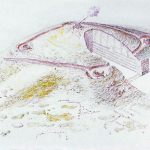
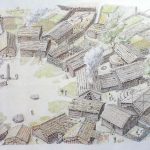
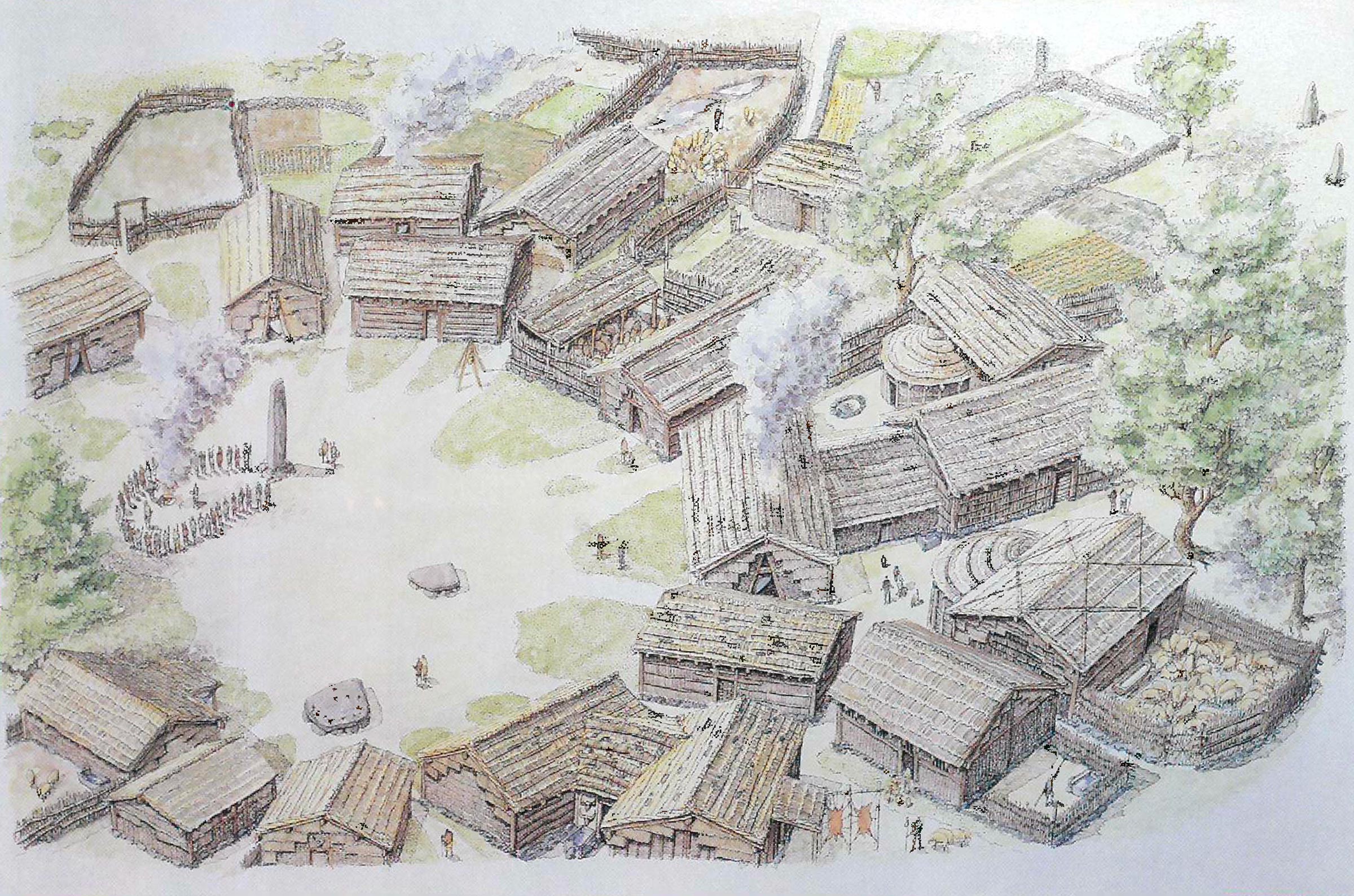
The village associated with the second temple, dated to the Copper Age (Abealzu Culture, 2700–2400 BC), had huts with straight walls formed by a plinth of small stones on which unfired bricks or reeds and branches rested, with double-pitched roofs. Among the structures, the most interesting is the so-called “Shaman’s Hut,” which owes its name to certain finds such as a female clay idol, a decorated loom weight, and a shell filled with red ochre.
Continue the visit
From here, you can continue the guided tour or return to the interactive map to choose another stop.
What are you looking at?
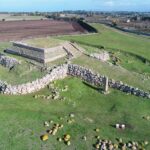
Before you stretches the area of the Eneolithic village, which developed east of the altar when, between the end of the 4th and the beginning of the 3rd millennium BC, a true “village-sanctuary” arose here. The huts, identifiable from traces on the ground, were made up of low stone walls supporting walls of mudbrick or plastered reeds and brushwood, covered by light roofs of poles and branches with one or two pitches. The objects found—pottery, querns, animal remains—tell the story of the daily life of the communities that lived alongside the sacred place.
Not far away is the so-called “wizard’s hut,” a trapezoidal structure divided into several rooms. Here large containers for foodstuffs were found, a hearth with querns and pestles for food preparation, numerous loom weights—including one decorated with small hanging discs—as well as a female terracotta figurine and a shell filled with red ochre. These finds reveal a place where domestic activities and ritual practices intertwine, closely linked to the functioning of the sanctuary.